imgadp

Top-Hot-Stocks

Hot Article ------ Favorites this page

2009-06-05

This Stock Market is a Fool’s Paradise

Bernard Baruch, one of the world’s most legendary speculators, said, “The main purpose of the stock market is to make fools of as many men as possible.

Right now, that’s exactly what’s going on. And I assure you, a lot of folks will be made into complete fools in the next year or so.

Chances are though, the folks who are going to look like fools are not who you think.

A Fool and His Money

The amount of bearishness from the market commentators is as strong as it ever was. The recent rally has only strengthened their resolve.

The thing is though, market meltdowns don’t happen when everyone expects them to. They happen when everyone is feeling safe. They happen when the market is overconfident. They happen when no one can find a reason not to buy. Right now, there is none of these.

The big money managers still don’t feel safe. The CBOE Volatility Index (a.k.a. the VIX or the Fear Index) is still at 31. The VIX is calculated by taking the implied volatility of option contracts on the S&P 500.

Simply put, the VIX is a measure of “portfolio insurance.”

When the VIX is high, the cost of insurance is high. It’s like buying catastrophe insurance for a house in Florida. The cost of insurance is high because of all the hurricanes. The perceived risks are high and that risk results in a higher cost.

When the VIX is low, it shows the cost of insurance is low. Right now, with the VIX at 31, it’s still relatively high. For instance, the VIX soared to a peak of 89 during the market extremes of 2008. The VIX, however, fell to less than 10 during the steady bull market between 2003 and 2007.

Basically, the cost of insurance is still high because the perceived risks are high. That perception still hasn’t changed.

Fools Rush In - at the Worst Possible Time

Most investors were absolutely crushed last year. There were very few safe havens outside of gold and U.S. Treasuries (And how many folks loaded up on both of these seemingly diametrically opposed assets?).

Almost everyone lost money – in most cases, they lost a lot of it. The effect of that is no one wants to take very much risk.

There are hundreds of thousands of investors thinking, “Sure, inflation is coming. And I’ll essentially be losing 6% a year in real terms. But hey, that’s a lot better than 45%.” But still, the safety and security of not having to fear of having to open the monthly brokerage account statement is a welcome relief to many.

Remember, confidence is slowly gained and easily destroyed. That’s why stocks go up slowly and fall quickly. Just like the old saying says, “Stocks go up stairs and down an elevator.”

Just take a look at how long it took for the markets to get its confidence back after the tech crash. After the steady collapse of the markets between 2000 and 2002, investors didn’t want much to do with stocks. They were very few bright spots in the economy and no one knew when or how the recession was going to end.

It took two years for the “true bottom” to form. There were plenty of starts and stops. The markets would jump and then fall right back down. Most investors simply threw in their collective towels during that period. Of course, looking back, it was a terrible time to sell out of the markets.

A Fool’s Hope: Buy High and Sell Higher

Now, look at what just happened. Between October 2007 and March 2009, the markets just continued to slide. Sometimes the fall was slow. Other times the down days were strung together five or six at a time.

Any sense of confidence in the markets was completely shaken out. The downturn was sharp and fast. Everything was going down.

Even the most experienced analysts and traders were a bit thrown off. Retail investors – a.k.a. average Joe investor – reached a near panic. They wanted out, wanted out completely, and they wanted out now.

Too see how badly they wanted out during this downturn compared to the tech crash, just look at the chart below which tracks mutual fund inflows and outflows.
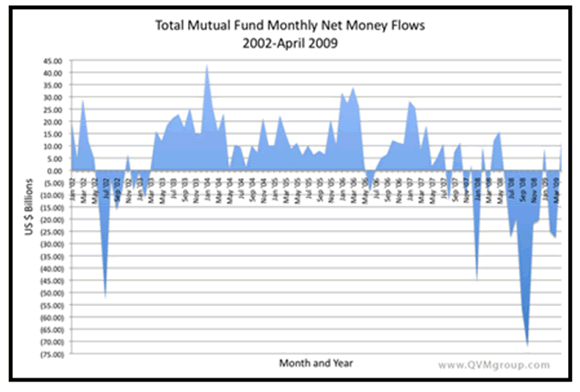
Pretty big difference between the two, huh?

The data in the chart comes from the Investment Company Institute and it was compiled by analysts at the QVM Group. The chart shows how long it’s going to take to “recover” from the recent market downturn.

The VIX shows us the swashbuckling confidence and excessive risk-taking isn’t coming back for a long time. Fear is still high and the rules of investing when fear is high is a bit different.

A Juiced Market

This is a time when market movements accelerate everything.

Like most baseball players, the market is juiced. Everything is bigger and faster. Gains are bigger and come faster. Losses too are bigger and come faster. Volatility is still exceptionally high.

This is a key part of the long-run bottoming process. Remember, the market’s goal is to make a fool of as many people as possible.

That’s exactly what it’s doing right now.

The market starts going up for a while and sucks people in. Then it falls down again.

It moves up a little bit more and sucks more in. Then down.

It’s an unpredictable cycle that repeats again and again. It always ends the same though. It ends with one big rally that sucks everyone in.

And that right there is why I’m not bearish yet. We haven’t had the “big one” yet. Heck we might even be in it right now. But it’s not about to end now.

First, there are still $3.7 trillion on the sidelines. That’s a lot of money that hasn’t come back into the markets yet.

Also, the money from the $787 billion stimulus package has not been spent. According to Recovery.gov, less than 6% of it has been spent so far (insert joke here about how amazing it is to see how slow the government is at spending this money or about how big an “emergency” it really was).

Finally, the market is rising which helps create a positive “wealth effect.” With more than 70% of Americans owning equities directly or indirectly through mutual funds that has a big impact.

Think of a 55 year-old person who saw their $1 million portfolio fall to $500,000. It took six months to get used to the loss, but now it’s up to $600,000. Yes, I realize inflation will make that much less valuable in the long-term, but that $100,000 paper gain will impact whether he takes the wife out for dinner or not.

Those are all factors why I believe this rally could last a lot longer than most expect. Sure, there are plenty of problems lurking on the horizon. There are Alt-A mortgages and option-ARM’s which need reset. And interest rates will play a big role. And huge government deficits which have no near-term solution (well, at least one which is politically feasible anyways).

Coming Full Circle

That’s why I think this market is a “Fool’s Paradise.” And depending on which stage in the investor life-cycle you’re at will have a big impact on how well you do during this extended rally.

I remember when I just started investing. I did exceptionally well. I bought stocks as they were rising. I would sell after they climbed a bit. Some would go up 10% in a year. Others would go up 50% or more.

In hindsight, I had no idea what I was doing. But my strategy was simple. I bought stocks which were going up.

As I learned more, I became more confident in my skills of fundamental analysis and others. I reached the second stage. I knew something, but not enough. I loved how complicated it was and learned how to look at companies from a fundamental perspective.

I would wage a personal financial battle against the markets. I would find something I considered of value and buy it. And continue to buy it. There was no discipline or focus on risk. Of course, I was a bit overconfident. I was downright dangerous.

Here we are a few years later and I feel lucky to have reached the final stage. The point where you know one thing – don’t bet against the markets. It’s also the point where you ask, “How much can I lose,” before asking, “How much will I make?”

That’s why, despite all the bad news out there and the plenty more which is to come, there are plenty of opportunities here. One of our mantras has been to take what the market gives us and, even though we’ll have a few more down days like today, the market is giving us opportunities on the long side.

A Structural Change in the Global Debt Based Financial and Economic System

Brett Jordaan writes: What politicians and central bankers around the world are either neglecting to tell us, or to consider, is that the current economic crisis, now a global recession and fast becoming a depression, is a result of a fundamental structural shift in the very makeup of the world economy. The credit crisis is widely accepted as the trigger for the current economic woes, but those who take a broad view of the world will see that our current predicament was actually years in the making, and ultimately, inevitable. As inevitable as the collapse of a house of cards, or the implosion of a Ponzi scheme. In fact, the global monetary system actually fits the description of a Ponzi scheme.
In your standard Pyramid or Ponzi scheme, those players that get in early are paid out by those that enter underneath them, who are in turn paid out by those that they recruit below them. Now from an objective distance, anyone with a right mind can see that Ponzi schemes are destined to fail, as their existence is predicated upon a continuous stream of players or “investors” entering the scheme with new money. From a simple perspective, if one considers that nothing is actually produced and no net benefit is gained through such a scheme, it becomes evident that they are doomed to collapse, almost intended to do so by design.

But Ponzi schemes have and do exist, and some have managed to prevail for a surprisingly long period of time, al la Bernie Madoff’s gigantic scam. In a staggering testament to personal greed and complacency, people became blinded in their pursuit of profit, ignoring the warning signs for well over a decade. This is a classic example of the human tendency towards cognitive dissonance.

Cognitive dissonance in terms of investing is a psychological term to describe the phenomenon whereby investors will change their memories to suit their desired outcomes. Thereby previous wins become exaggerated with importance and losses are either forgotten, or relegated to the unimportant far-flung corners of once mind. This is what has occurred in the public mind in accepting the legitimacy of the greatest, most pervasive Ponzi Scheme in all history; the current global monetary system. This is actually a number of inter-locking, interconnected Ponzi structures (the massive derivative bubble, the housing bubble, debt-financed national spending plans, etc), all underpinned and made possible by the existence of fiat currency.

Every fiat currency ( paper money that is not backed by anything except the “faith in the government”) in history since Roman times has failed, recent examples being the German Weimar Republic and of course Zimbabwe. It is clear that the world is increasingly losing faith in fiat currencies, as governments borrow ever greater astronomical sums to finance record deficits and central banks print ever greater quantities of paper, or “money” as it is currently called, to finance spending. This is evident in the surge in the price of gold , which is the only currency to maintain its value throughout history and was in fact the only value behind the strength of the world’s currencies until the final abolition if the gold standard by US president Carter in the 1970s. Since then we have embarked on a grand global monetary experiment, where no country’s currency is backed by anything tangible, except the “full faith of the government”, whatever that’s supposed to mean.

The current structure of the world economy is so unbalanced and unsustainable, it is a wonder that we have not entered into a crisis earlier. When one considers that the majority of the economies of the Developed West, such as US, UK and Western Europe, are driven by consumption, and those of the East through manufacturing and exports, the cause of the “recession” begins to become apparent.

The West consumes goods made by the cheap workshops of the East. But the West cannot afford to buy the East’s goods, so it borrows money in order to buy more. Take the world’s largest economy, the United States. Over 70% of U.S. GDP is attributable to consumer spending. In a nutshell, China manufactures cheap goods which are consumed in the U.S. and paid for by money borrowed from China. So every month, the U.S. govt sells IOUs (Treasury bonds) to China, enabling the US to buy more of China’s goods. Every month the U.S goes into greater debt and every month China saves more dollars.

The irony is that as the Fed (US Federal Reserve) prints ever greater sums of money (most notably recently through “quantitative easing”), China will be left sitting on a pile of steadily declining Dollars as the inevitable devaluation that results from oversupply of money takes hold.

China knows this and this is why it has been making calls for a new international reserve currency and has tripled its gold reserves in 8 years.

Another irony here is that this scenario is a mirror image of what has happened at a household level, where individuals have spent more than they earned each month, and borrowed to pay for it. The main source of financing was of course home equity, which entered a massive bubble caused by the creation of cheap credit (easy money) by the US Federal Reserve and central banks around the world. Households went on a spending binge on the crazed basis that home prices will always rise. Similarly, the U.S govt has entered on a spending binge on the failing assumption that the world will continue to loan it money and to demand continually devaluing dollars.

The U.S. makes little of real value, and it would have entered into serious recession to rectify this a long time ago, had the US dollar not been in the enviable position as the world’s reserve currency.

Now the engine of growth in the US and the West has seized, as the housing bubble continues its inevitable collapse and consumers logically reduce their spending to rational levels. People are actually saving, as the light of sanity shines some truth on the utter lunacy of continual throwaway consumerism.

Unfortunately it seems that sanity is incompatible with running a government and economy nowadays. The solution to our problem trumpeted by the US and other governments is…. More DEBT! Yes, we must borrow and spend our way out of this mess they say. Oh, and if we cannot borrow at a national level (because other countries are seriously starting to doubt lending us money), we’ll print more money to magically create wealth and go back to the good old days of borrowing to buy a lot of junk we just don’t need.

Now I find it very difficult to believe that Nobel prize-winning economists and the brilliant central bankers are experiencing such tremendous cognitive dissonance, that they actually believe that the current system can continue, or in fact be rejuvenated by more of the actual causes of this crisis. More spending and more debt, to solve the problem of excessive spending and excessive debt.

Is it just me, or are we being taken for a ride? Are the people in control deliberately sending us headfirst into an economic and social catastrophe in order to gain more power and take more of our feeedoms, or are they so incompetent that they do not see the writing on the wall?

We are in a structural recession. The global economy is structurally adjusting into a more balanced and sustainable system, one driven by savings and production, not borrowing and debt. Savings will finance investment in production of goods and services that actually provide a benefit to society and the biosphere. We live in a world of finite resources. Continual population growth, consumption and environmental degradation are not compatible with this reality.

Any attempts to turn back the clock, to return to that hitherto unsustainable status quo will just cause this transition to be more painful. The excesses of the past are gone and those that realise this and adjust their lifestyles and paradigms, will be the pioneers of the new age to come. It seems that we cannot trust our leaders to solve this problem, it is up to each of us to have the courage to face change, and embrace the opportunity it brings.

Best regards

Bullish Formation for Financial Stocks XLF ETF

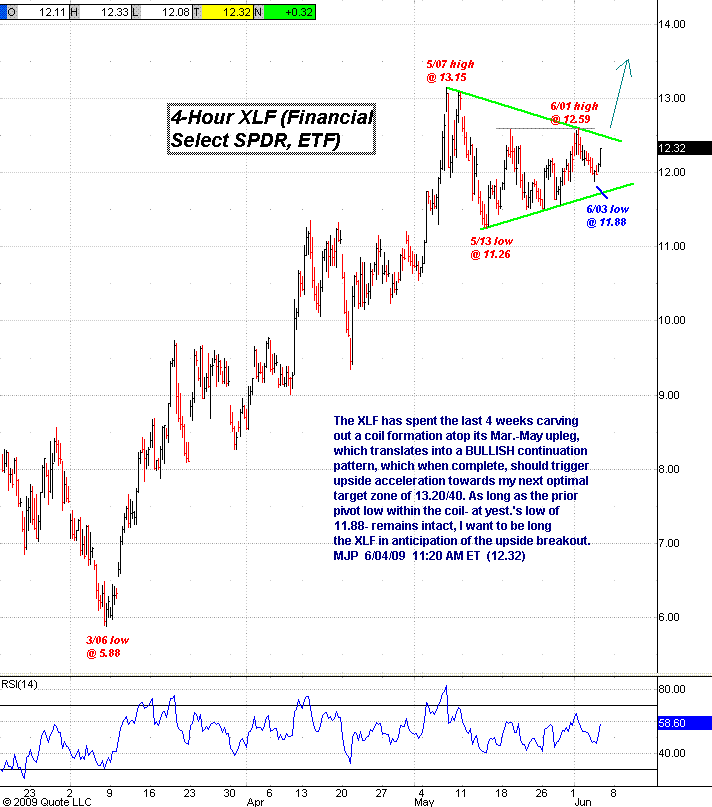
The Financial Select Sector SPDR (AMEX: XLF) has spent the last 4 weeks carving out a coil formation atop its Mar-May upleg, which translates into a bullish continuation pattern, which when complete should trigger upside acceleration towards the next optimal target zone of 13.20/40.  As long as the prior pivot low within the coil – at yesterday’s low of 11.88 – remains intact, I want to be long the XLF in anticipation of the upside breakout.

The Plummeting U.S. Dollar Economic Prosperity Plan

It is becoming painfully obvious that the Fed, Treasury, and Administration's disastrous recovery plan hinges on the devaluation of the U.S. dollar. Their specious strategy stems from the belief that a falling currency can re-ignite exports and spark a recovery in manufacturing while putting a floor in U.S. asset prices. But just as the President's initials indicate, the plan stinks of B.O.
Firstly, a falling currency does nothing to expand a country's exports or domestic production. Let's say for example, country "A" has a dollar that is trading in parity with that of country "B". Let us then assume that country A departs on a currency printing policy that mimics that of the United States. Let's also say that because of the increased supply of newly minted dollars, the value of country A's currency is eventually cut in half. Then, just one unit of country B's currency can be exchanged for two of A's dollars. The mistaken belief held by those who espouse a weak currency is that now country B can buy two dollars worth of goods with just one unit of their currency--thus expanding the foreign demand for A's goods and ushering in a manufacturing boom.

However, what they neglect to understand is that the inflationary policy of A has not left the dollar price of the country's goods static. In fact, the value of goods and services provided by A should have doubled as the purchasing power of the currency was halved. The result being that country B is immune from A's inflation and can purchase the same amount of goods with just the same amount of money.

The resulting problem is that not only has A done nothing to stimulate domestic production, it has discouraged foreign investment while destroying the purchasing power of the dollar, sending prices for both domestic and foreign purchases out of reach for the average consumer. The resulting inflation eventually discourages domestic manufacturing because the purchasing power of the country's middle class and poor is wiped out. The result of skyrocketing prices is that discretionary purchases are eliminated, causing massive job loss and plummeting GDP output.

History clearly shows any such currency devaluation strategy to be a complete failure. In 2005 China announced it would increase the value of its currency and abandon its decade-old fixed exchange rate to the U.S. dollar in favor of a link to a basket of world currencies. Since then the Yuan has rallied from .1208 USD to .1467 USD. But the falling dollar has had a negligible effect on U.S. exports. For all of 2005 the U.S. deficit with China was $201.5 billion. In 2008, three years into the dollar devaluation, it soared to $266.3 billion. And despite the worst economy since the great depression--which caused U.S. imports to decline sharply--the annualized rate for 2009 is still $201.2 billion.

If all a country needed to do to achieve manufacturing supremacy and economic dominance was devalue their currency then Georgia and Bosnia would be considered paragons of economic prosperity. That's because a country's economic health, productive output and balance of payments has less to do with the value of the currency and more to do with tax rates, union influence and environmental legislation.

As long as we continue to substitute spurious growth models for genuine growth policies we will continue to lose global power and influence.  The only part of the current plan that is sure to work is the cessation of falling asset prices. Unfortunately for us, that will come at the risk of creating intractable inflation and putting our foreign creditors on notice that we will destroy not only the value of their U.S. dollar holdings but the very value of the currency in which they are denominated. Who does Mr. Geithner think he’s kidding? The Chinese have already moved to purchase short dated Treasuries so as to allow them an easy escape. They may also dramatically curtail their purchases. For a country that needs to issue nearly $3.25 trillion dollars of debt this year alone and trillions of dollars for many years to come, that is disastrous for this debt-laden economy.

Intel Makes Move Into New Market

Intel Corp. (INTC: 16.13 +0.19 +1.19%) announced plans to buy software firm Wind River Systems Inc. (WIND: 11.76 +3.76 +47.00%) for $884 million on Thursday in a move that will help it to step out of the traditional semiconductor market and expand into the consumer electronics space.

Intel is paying $11.50 in cash for each share of Wind River, valuing the company at a 44% premium to its Wednesday close. Wind River makes software systems for wireless devices and a host of other embedded computing gadgets, two key areas Intel has been eying for growth.

The acquisition of the Alameda, California-based company is the first major deal signed by Paul Otellini since he became chief executive of the world’s largest semiconductor maker back in 2005. The deal is also being considered by industry experts as a strategic move on Otellini’s part amid a large-scale consolidation spree in the technology sector.

As cash-strapped consumers cut back spending on personal computers, Intel’s revenue slumped 26% in the latest quarter. Thus, the company is now seeking alternative sources of income and looking to diversify through acquisitions.