imgadp

Top-Hot-Stocks

Hot Article ------ Favorites this page

2009-06-21

The Wall Street Clown Show

It’s been a while since I laughed out loud while going through the news, but that’s just what happened when I read the following Reuters report, “JPMorgan’s Lee Sees S&P 500 Retest of ‘07 Record.” As a service to loyal Financial Armageddon visitors, I thought I’d do them the favor by highlighting all the ridiculous bits:

The benchmark S&P 500 index should surge back to its October 2007 record above 1,500 by the end of 2012, provided the U.S. economy sees a V-shaped recovery, JPMorgan Chase Chief U.S. Equity Strategist Thomas Lee said on Wednesday.

My take: And I should be the next president of the United States, provided I have enough write-in votes when the 2012 election results are tallied. In reality, the notion of V-shaped recoveries — especially after what we’ve been through — is one of Wall Street’s favorite (unfulfilled) fantasies. Otherwise, for reality-based insights on the impact of financial meltdowns, read “The Aftermath of Financial Crises,” by professors Carmen Reinhart and Keneth Rogoff).

“The global economy is in the midst of a synchronized recovery,” Lee said at the Reuters Investment Outlook Summit. “If we end up with a V-shaped recovery, we could go back to our record high of 1,500 in 2011-2012,” he added, referring to the S&P 500.

The S&P 500 fell 0.4 percent to 908 on Wednesday.

My take: “Synchronized recovery”? Say what?! Not according to data published just weeks ago by economics professors Barry Eichengreen and Kevin O’Rourke, in a post at voxEU.org entitled, “A Tale of Two Depressions.” Below is just one of their highly illuminating graphs (no sign of a rebound here, that’s for sure):

Worldoutputthenandnow

Lee also reiterated his year-end 2009 target of 1,100 for the S&P 500, saying the United States will likely come out of its recession some time this summer, followed by the rest of the developed world.

In October 2007, the S&P 500 hit a record closing high of 1,565.15, before falling back. In March of this year, it slumped to a 12-year closing low, but has since rebounded by about 40 percent on hopes the recession that begun in December 2007 was moderating.

My take: In March 2008, Lee was counting on a “short recession,” had penciled in a year-end price target of 1450 for the S&P 500, and was expecting “financials to lead the market higher,” according to CNBC. So far, at least, there’s no real sign that this allegedly “brief” downturn has ended, and anyone who bet on the JPMorgan “strategist’s” prior call on U.S. equities managed to lose his or her shirt last year, because the broad market finished down 38% at 903.25, while the S&P Financials regurgitated more than half their value.

Lee added that a market correction in the wake of the recent run-up would be “healthy,” and could lure back investors who opted to sit out the recent rally.

“This rally has left many investors uninvested or underinvested. The pullback is the entry point to really see more meaningful money put to work,” said Lee, who has been named a top analyst in Institutional Investor magazine’s annual all-star poll.

My take: not content to lead the lambs to the slaughter like he did last year, Lee is determined to fully eviscerate his followers without any real justification other than a reliance on the greater fool theory. Otherwise, in an interesting Freudian slip, Lee more-or-less acknowledges that the recent “green shoots” rally has not had much in the way of “meaningful money” behind it.

He favors the financials, industrials, technology and consumer discretionaries sectors, in that order, saying the sectors would be the biggest beneficiaries of an economic recovery.

Within financials, he favors asset managers.

The S&P financial index is up 84 percent since the broader market’s 12-year low on March 9.

“We are still favoring cyclicals over defensives,” said Lee. Even so, he was mindful of potential risks to the recovery.

“The biggest risk is that we’re implicitly assuming the consumer is stabilizing. There’s a lot of potential shocks. If oil goes to $100 a barrel, you can’t have a recovery,” said Lee, adding the other risk would be if savings rates somehow overshoot.

My take: even though reports clearly indicate that consumers are terrified about the future and are continuing to scale back, the housing market remains in the doldrums (or in the tank, depending on where you live), and personal consumption rates, savings rates, and debt levels are still on the wrong side of long-term averages, Mr. Lee assumes “the consumer is stabilizing.” Why stop there? As long as we’re talking BS, why not go a step further and “assume” that the consumer is flush with cash and starting to spend money like a drunken sailor?

One would have thought that after having been SOOOOO wrong about the events of the past two years, those who call themselves “strategists” would have sought out a more productive line of work.

Instead, all we keep seeing are endless reruns of the Wall Street Clown Show.

Stay tuned for plenty more?


Boeing And The USAF Tanker Program: The Plot Thickens

Boeing (BA: 48.44 -0.52 -1.06%) apparently is considering proposing on the upcoming USAF Tanker Program re-bid with versions of two of its models — the 767 and the 777 — in the hopes that one of them will be selected over the single Northrop Grumman (NOC: 47.11 -0.26 -0.55%)/Airbus A330-based submittal. The following is provided for those of you interested in the specifications — and the differences — between the three aircraft (for the Boeing 777-based version, we have used data for the 777 Freighter as being probably closest to the final configuration):

In case you’ve forgotten, the current KC-767 has no cargo capacity, as it is solely an aerial-refueling tanker, which is what Boeing may have thought USAF wanted during the last tanker tussle. Instead, USAF picked a version of the A330 MRTT — an aircraft with cargo capability — which means it can also be configured as a troop carrier, which may be one of the reasons USAF doesn’t want any more C-17s.

It’s all becoming clearer now: if you’re not going to buy KC-767s and you’re not going to procure more C-17s, the least USAF can do is buy KC-777s. Not only that, but Boeing reportedly is thinking about producing the KC-777 aerial tanker in Everett, which would make most of us living in Western Washington State a bit happier than even the last thirty days without rain have done.

If you take a look at the specifications, you will notice that the A330 MRTT is sandwiched in between the KC-767 and KC-777. However, if USAF wants a multipurpose aircraft with the most capability, the KC-777 is quite possibly the aircraft of choice.

In any event, the re-bid is a happening thing, and we may soon know if U.S. commercial aircraft production will continue to be centered in the Pacific Northwest or will begin to shift to the Gulf Coast — for if the A330 MRTT wins, it will be completed in Mobile, Alabama…and once Airbus has a toe-hold in the USA, there’s no telling what comes next.

Incidentally, USAF’s version of the A330 MRTT was ultimately dubbed the KC-45, so as to not confuse it with anyone else’s A330 MRTT tankers.

Let the bidding begin!

Some Preliminary Thoughts On Regulatory Reform

Increased Powers for the Fed

The rhetoric so far is exaggerating the extent of new powers for the Fed. Since the major investment banks converted to bank holding companies (BHC), the Fed already is the primary regulator, at the BHC level, of the largest financial institutions. Nonbanks like AIG  would represent some expansion, but even that was taken on last year on an emergency basis.

A New Consumer Protection Agency

If I were still president of the Dallas Fed, I’d be happy to lose this function for selfish reasons. Consumer “advocates” are very aggressive and often abusive in their approach. Good riddance!

For the good of the country, however, putting this function into a specialized agency that doesn’t have other responsibilities that bring balance into the picture is a bad idea. Over time these advocates will find themselves pushing on an open door, and the agency itself will become an advocate of proposals that appear consumer friendly on the surface, but will likely have adverse unintended consequences for consumers.

Abolishing the Office of Thrift Supervision

This isn’t necessary on quality grounds. They do as good a job as the bank regulators. Hopefully, their personnel can be folded into the new banking agency.

The elimination of the federal thrift charter may be a good idea. Thrifts are currently prevented by their charters from diversifying sufficiently out of real estate lending. Morphing them into banks will make them safer.

More to come later.


General Electric Looking Better And Better

As the details of yesterday’s shareholder meeting at General Electric (GE: 12.10 +0.13 +1.09%) hit newsstands, we are left with the impression that GE is looking better and better as an investment.

Yes, shareholders were pretty livid about the dividend cut and the amount of CEO Jeff Immelt’s compensation. Yes, earnings have dropped 35% and GE has a number of divisions like it’s entertainment and financing units that have performed poorly. And yes, there was even talk of breaking up GE into smaller companies.

But it’s all a smokescreen.

GE is looking better considering its size, and markets that it serves. In fact, earnings actually beat forecasts. Yes, forecasts were low - but again who cares, earnings forecasts have all been guesswork anyways over the last few quarters.

After the dotcom bust, GE shares were cut in half. Since its high of over $41 in 2007, the share price has plummeted even worse, over seventy percent. But it’ll come back.

GE is looking better as one of the broadest reaching companies producing some of the most complicated products on the planet. From engines to turbines to power plants, GE has made itself a player across almost all sectors and most countries.

We’ve talked before about how GE is closer to a mutual fund than a single stock, but the truth of the matter is that GE will emerge from this recession as it has from past ones - just as strong. Picking up some GE stock at below $15 is about the clearest long-term value play we can think of.

California Tax-Free Bonds Are Still A Great Buy

Too big to fail. That’s getting to be a weekly headline here in the States. The big economy in the quote above is the state of California’s. In case you didn’t realize, California by itself would make for the world’s eighth-largest economy.

Things are crazy out there. The state faces a $24 billion budget shortfall… and big tax hikes ahead. Nevada, Florida, and Arizona are in the same shape.

You might think all this budget trouble means it’s a bad time to loan money to these guys. But I’m actually urging readers of my Retirement Millionaire advisory to keep on loaning money to states - to keep buying “municipal bonds.”

Understanding “muni bonds” is simple. In order to fund things like highway projects and water systems, states borrow money from individual investors. To entice folks to invest with the government, interest earned on these bonds is exempt from federal taxation.

That means if California’s muni bonds are paying out 6%-7% in interest payments, it’s the equivalent of getting a 9%-10% yield on any other kind of interest-bearing investment. You also have the extraordinary power of the government looking out for you. The alternative to you not getting paid is for the state or city to go bankrupt.

Right now, though, investors are scared of muni bonds. You see, back in 1975 and 1978, New York City and Cleveland defaulted on their debt. People are worried that’s going to happen again.

But folks are missing a big thing here: If Washington D.C. isn’t going to let GM, AIG, or Citibank go belly-up, do you really think they’ll let a big state go bankrupt? I’m not in favor of any bailout, but that’s the game we’re playing.

My favorite way to own muni bonds is through “closed-end funds.” These investment vehicles aren’t like regular mutual funds… They can trade for premiums and discounts when investor sentiment gets out of whack. Oftentimes, you can use closed-end funds to buy a dollar’s worth of assets for 85 or 90 cents.

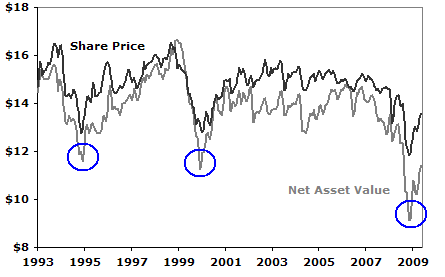
And that’s where the opportunity is today: closed-end muni-bond funds that are trading for much less than their “net asset value.” Right now, we can buy several closed-end California municipal funds for as cheap as 84 cents for every dollar of assets.

Consider the last two times the markets did this. In 1995, you could buy $1 of muni bonds for 85 cents. And in 1999, a dollar’s worth of these bonds cost 86 cents. The chart below of MCA (a BlackRock fund of California munis) shows these extremes. Every time the gray line dropped below the black one, you could buy munis at a discount.

Buying Munis at a Discount Leads to Big Gains

As you can see, buying when the fund traded at a discount led to capital gains within a couple years. Not to mention the tax-free income along the way.

The state of California is in trouble. The price (low) and yields (high) of its municipal bonds show it. But you can be sure Obama and the current federal government will not let the state slide into the ocean and default on its obligations to investors. This provides us with an incredible opportunity to buy high-yielding discounted municipal paper.

A lot of closed-end funds own nothing but California bonds, including MCA. If you’re a real contrarian, consider buying these. Many are going for double-digit discounts.

If you want a safer bet, take a look at more diversified funds that own bonds issued by many different states.

Bottom line: Don’t get scared out of these tax-advantaged bonds. They’re still a good source of income at arm’s reach from the taxman.

Here’s to our health, wealth, and a great retirement.